
Rice County Release Date Meanings
One Rice County release date cannot answer every release question. Legal eligibility is the earliest point at which the governing law may permit a person to leave secure custody. A Rice County projected date is the agency's current calculation or, in a Board case, a date assigned through a decision. The actual release date and time record the completed physical event. Eligibility can exist before release, and a projection can change before it occurs.
A Rice County pretrial detainee at the Rice County Jail generally has no sentence-based date to calculate. A judge may set bond or release conditions, issue a later order, dismiss the case, or keep the person held. A separate warrant or detainer can also affect departure. For a sentenced Rice County person, the signed judgment and the agency that administers the sentence define the proper route.
| Date concept | What it answers | Best source |
|---|---|---|
| Eligibility date | When release could first be legally considered | Current statute, sentence, or Board record |
| Projected date | When the agency now expects a custody change | DOC detail or jail calculation |
| Actual release | When staff completed release or transfer | Jail or DOC event record |
Find Rice County Release Dates
Identify the Rice County custody system before searching. The Minnesota DOC Public Viewer covers people committed to the commissioner. It is not a statewide archive of every Rice County Jail stay. Someone who posted bond or served a local misdemeanor term may have no DOC record. Conversely, a person who disappeared from the Rice County roster after commitment may be in DOC custody rather than released to the community.
- Determine whether the person is held pretrial, serving a county sentence, or committed to the Minnesota DOC.
- For a state case, open the DOC Public Viewer and search by full name or OID.
- Compare identifiers, then transcribe the exact status and release-related date label displayed.
- For a county sentence, obtain the signed sentencing order through the court and ask Rice County Jail for its current calculation.
- Ask about another hold, transfer, or destination before describing the date as community release.
- After the date passes, verify the actual event rather than relying on the earlier projection.
The Rice County released-inmate search supplies the full custody and record route when the holding agency is uncertain. For a state sentence, the DOC Public Viewer is the direct public search.
The official search interface captured below shows why an OID and a careful identity match are more reliable than a name alone.
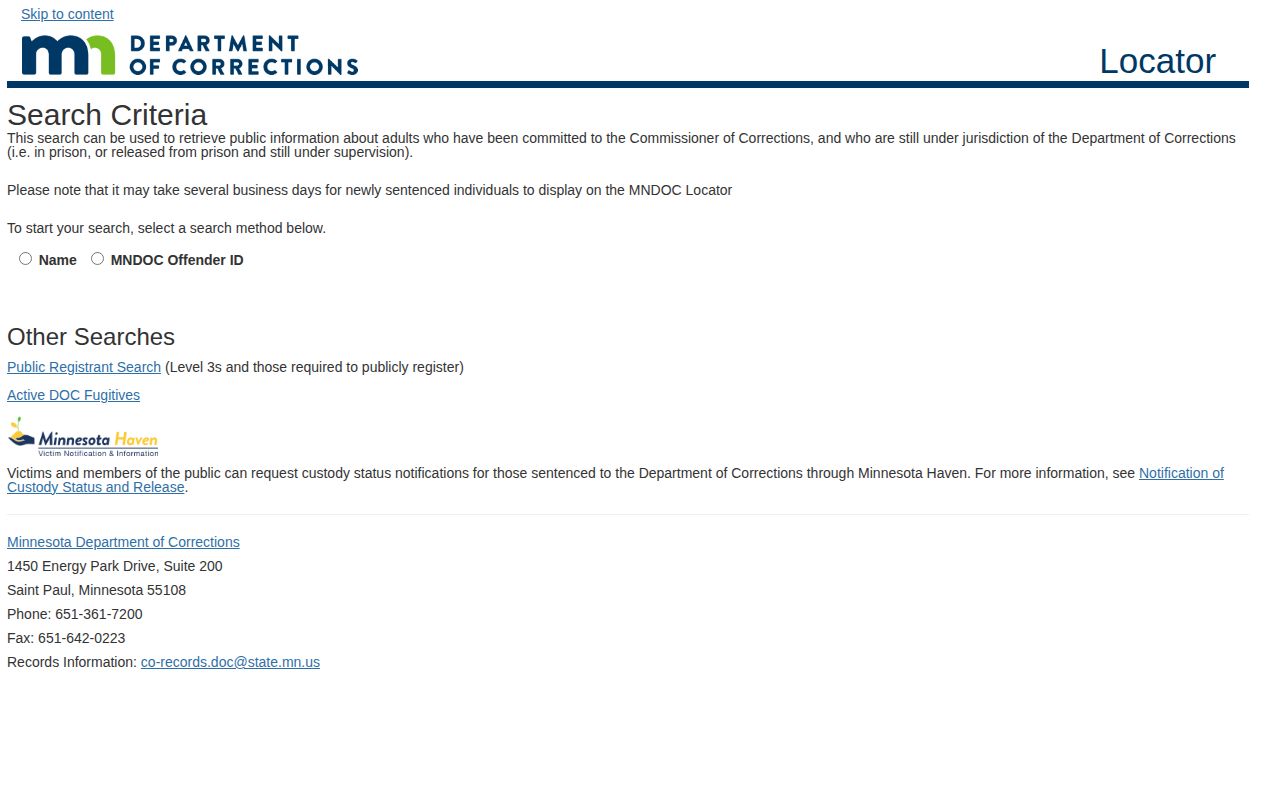
The result detail, not the blank form, supplies the case-specific status and date terms that must be preserved.
Rice County DOC Release Labels
Rice County searches of Minnesota prison records can encounter several date concepts. A supervised release date, conditional release, sentence expiration, parole eligibility date, projected release date, and Board-assigned projected date are not interchangeable. The label depends on the sentence population and current status. Copy the label exactly instead of turning each one into a generic Rice County release date.
Supervised release means the person has left secure prison but still serves the sentence in the community. Discharged or sentence expiration generally marks the end of the DOC sentence, subject to the precise record and any authority from another jurisdiction. A change from MCF-Faribault to another DOC facility is a transfer. It is not release.
- Projected
- A current forecast or assigned future date that remains subject to change.
- Supervised release
- The community portion of a Minnesota DOC sentence.
- Conditional release
- An added or specialized release term created by the applicable sentence law.
- Expiration
- The sentence endpoint shown by the responsible agency, not merely departure from prison.
When the DOC record shows community supervision, confirm the responsible office. Rice County Community Corrections serves prison releases assigned to Rice County, but a person who physically leaves MCF-Faribault can report elsewhere. The prison's location does not set the county of supervision.
Rice County Has No 85% Rule
A Rice County release estimate should not use a generic rule that everyone serves 85 percent before release. For many ordinary determinate prison sentences, the familiar Minnesota framework is two-thirds as the term of imprisonment followed by one-third on supervised release. That is about 66 2/3 percent confined, not 85 percent. The Rice County person remains under the sentence during the community portion.
The framework is not a personal calculator. The governing law can depend on the offense date. Jail credit, mandatory minimums, consecutive or concurrent terms, conditional-release statutes, disciplinary confinement, and special release programs can change the practical date. A violation during supervised release can lead to return to custody and a new projected confinement release date.
Minnesota Statutes section 244.05 is the principal supervised-release provision. Its captured text is shown below as the legal source for the release framework, not as a substitute for a person's sentence record.
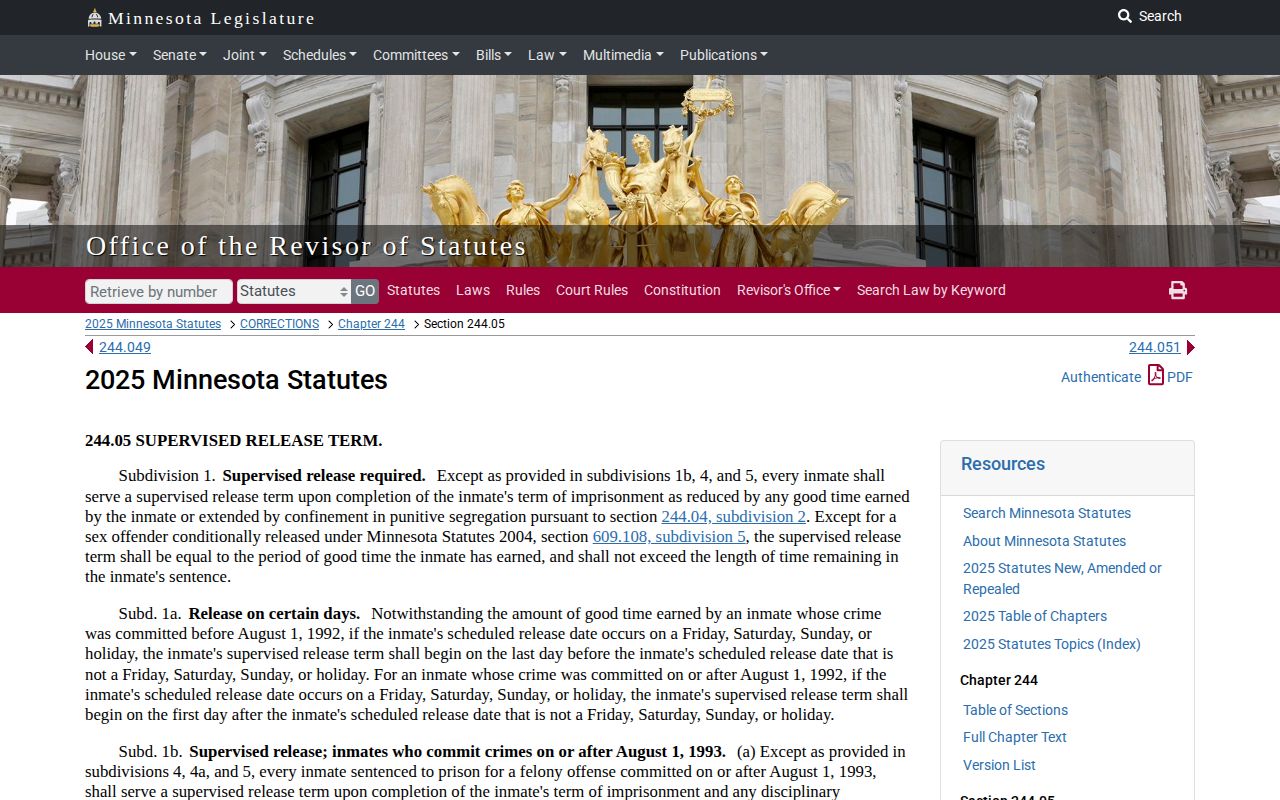
The exact sentence cohort and DOC label remain more useful than any broad percentage applied without the judgment.
Note: The Minnesota two-thirds framework describes many determinate prison cases, but it must not be applied to every offense or sentence.
Rice County Earned Release Credits
A Rice County projected release date in a modern Minnesota determinate case should not be explained as a simple day-for-day good-behavior discount. Older statutes used earned good time for older offense groups. The current system also includes earned incentive release under chapter 244 for eligible people who work toward an individualized plan. The proper name and current rules matter because the programs are not the same.
Earned incentive release depends on eligibility, exclusions, a person's plan, satisfactory progress, and DOC implementation. A credit may change the projected secure-custody release point without erasing the sentence. The remaining part is served in the legally required community status. Because the calculation and implementation can change, rely on the current Minnesota Statutes chapter 244 and the person's DOC record. Do not merge this framework with the pre-1993 good-time system or promise that conduct alone produces a fixed reduction. The public date is an agency calculation tied to the person's case and current record.
Discipline, lack of completion, a sentence correction, or release-plan issues may affect a displayed date. Ask the DOC which exact date label is shown, whether it is projected or completed, and what supervision follows. A broad promise of “good time” is not a sourced Rice County answer.
Rice County Jail Date Math
A Rice County jail term should not be calculated by taking two-thirds of the announced sentence. Minnesota law distinguishes many sentences under one year to a county jail or other authorized local place from felony commitments of one year or more to the commissioner. The signed Rice County judgment controls the starting facts for the local calculation.
Read the executed days, jail credit, concurrent or consecutive direction, stayed portion, court-authorized program or release terms, and any other holds. Concurrent terms run at the same time, while consecutive terms run one after another. A stayed part is not executed unless the court later orders it. Jail credit accounts for custody time recognized in the sentencing order.
Then call Rice County Jail at 507-332-6021 and ask for its calculated date. For a completed event, ask Rice County Sheriff's Records Staff at 507-332-6003 for the actual release or transfer time, event type, authority, and destination. If the person remains pretrial, ask about current custody and the court file rather than demanding a sentence calculation that does not exist.
Can a court date be treated as a jail release time? No. The order sets legal authority, but staff may still need to process release, check other holds, or arrange a transfer.
Why Rice County Release Dates Change
A Rice County projected date is a moving administrative fact. It can change because the underlying sentence, credit, conduct, or release path changes. Some factors alter the Rice County calculation. Others prevent a return to the community even when the person leaves the named facility.
| Factor | Possible effect | Source to check |
|---|---|---|
| Amended sentence | Changes the term or commitment reflected in the calculation | Court order and DOC update |
| Jail-credit correction | Adds or changes time credited toward the sentence | Sentencing record and agency calculation |
| Disciplinary consequence | May delay release from secure custody | DOC record or agency response |
| Earned incentive status | May alter the projected confinement point for an eligible case | DOC and current chapter 244 rules |
| New sentence | Concurrent or consecutive treatment can recalculate time | Court and DOC sentence data |
| Detainer or warrant | Can send the person to another jurisdiction instead of the community | Holding agency and destination authority |
| Release plan or Board directive | Can delay a Board-assigned or planned release | DOC or Supervised Release Board |
For life, indeterminate, and other Board cases, minimum eligibility comes before a release decision. The Board may set a projected date or continue review with directives, and it cannot release before the minimum term. Plan approval may still be required after a date is assigned.
Confirm Rice County Release Dates
For a Rice County DOC case, ask: What exact date label and value appear now? Is the date projected or completed? What supervision follows? Is another hold shown? Those questions preserve the agency's distinctions. If public data are unclear, use the DOC data-practices channel and request the existing sentence or release data. For Rice County Jail, ask whether the person is still physically held. If not, request the actual timestamp, event type, releasing authority, and destination agency. Cross-check the Rice County court judgment and later orders through MCRO.
Keep the Rice County result tied to its search date. A future date can be revised, and an older screen may no longer reflect the current calculation. If the person is absent from the current Rice County jail roster, do not fill the gap with arithmetic. That absence can mean release, transfer, a spelling mismatch, a data lag, or a record correction. For a Board case, separate minimum eligibility from the projected date assigned after review, then check whether directives or a release plan remain open. For an ordinary determinate case, focus on the DOC detail and supervising office.
For a pending county-jail event, Minnesota VINE can provide a custody-change alert. The Rice County VINELink check explains registration and the separate Minnesota Haven route for DOC cases. After receiving an alert, confirm it with the agency because a transfer and a community release can both remove someone from the prior location. For DOC custody, Haven is the notice channel, while the Public Viewer remains the public status check. A notification and a sentence record should support, not replace, one another.
Note: A past projected date should be replaced with the confirmed actual event once the responsible agency records that event.