
Rice County Parole vs Probation
These terms do not describe the same legal status. Rice County Community Corrections handles local probation and also serves people released from Minnesota prisons who reside in the county. The court imposes probation. The Minnesota Department of Corrections, or DOC, administers supervised release after a state prison term. Minnesota uses the word parole mainly for life, indeterminate, and other cases assigned by law to the Supervised Release Board.
A person can leave Rice County Jail on pretrial conditions without being on probation. Pretrial release takes place before the criminal case reaches a final result. A person can also leave the county roster because of transfer to DOC, which is not a community release. Read the court order, custody event, and corrections status together before describing the type of Rice County supervision.
| Status | How it begins | Best Rice County check |
|---|---|---|
| Probation | A court orders community supervision as part of a sentence. | MCRO and Rice County Community Corrections |
| Supervised release | A person serves the community portion of a DOC sentence. | DOC Public Viewer and the responsible field office |
| Parole | The Supervised Release Board acts in a case within its authority. | DOC record, Board material, and supervising office |
| Pretrial release | A judge permits release before final disposition. | Court order and Rice County Jail release event |
- Discharge
- The agency term for supervision or a sentence ending. Confirm which agency used it.
- Absconder
- A person alleged to have stopped reporting or evaded supervision.
- Detainer
- A request or legal hold from another authority that may prevent community release.
Verify Rice County Supervision
Start with the sentence, not the former jail listing. Minnesota Court Records Online, or MCRO, can show a public sentencing entry and whether probation was ordered. A case number is more reliable than a broad defendant-name search because the public name search has limits for pending criminal matters. Court data explains the judge's order. It does not always show the precise moment staff completed a jail release.
For a state sentence, use the Minnesota DOC Public Viewer. Compare the full name and OID, when known, and read the status label exactly. Supervised release means the person left secure prison but remains under the DOC sentence in the community. A facility change means transfer, not release. Then identify which local or state office is responsible.
- Search the court case by file number and read the sentence, probation term, later warrant entries, and discharge entries.
- Call Community Corrections with the full name and court file number, if available.
- Ask whether adult supervision is active, when it expires, who the assigned officer is, and which public conditions or status details may be given.
- For a prison sentence, compare the DOC status, release-related date labels, and supervision information.
- If another county or interstate compact office is responsible, ask for that office rather than assuming Rice County holds the file.
The broader Rice County released-inmate search path helps distinguish a community release from a jail-to-prison or agency transfer. That distinction should be settled before a supervision check begins.
Important: Absence from the current Rice County Jail roster does not establish parole, probation, discharge, or release into the community.
Rice County Community Corrections
Rice County is a Community Corrections Act county. Its local office serves adults and juveniles on probation and people released from Minnesota prisons. That makes the office a direct Rice County supervision source, even when the prison sentence began elsewhere. The place of confinement and the place of supervision may differ. Someone released from MCF-Faribault may report in another county, while someone released from a different Minnesota prison may report in Rice County.
The official Community Corrections page lists the office and its public hours. The captured office page below helps identify the correct county department before placing a call.
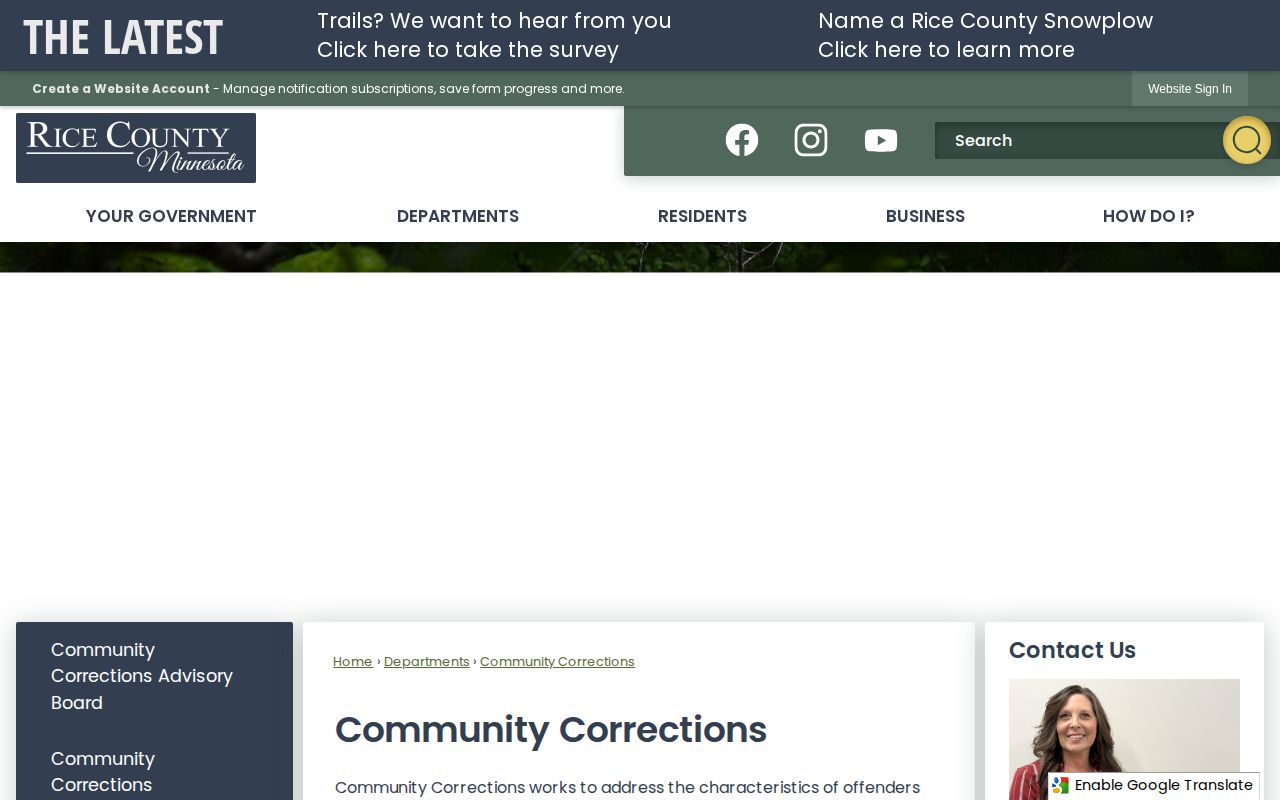
This local source is the best starting point for Rice County adult probation and locally assigned supervised-release questions.
Rice County Community Corrections
128 Third Street NW
Faribault, MN 55021
507-332-6106
Fax: 507-332-5981
Monday through Friday, 8 a.m. to 4:30 p.m.
Legal holidays excluded
Office hours are contact hours, not a promise that every detail is public or instantly available. Give enough information to separate people with similar names. Juvenile access follows narrower rules than adult access.
Rice County Adult Probation Details
Rice County's official probation-status FAQ gives a useful local disclosure rule. Most adult probation information may be requested by phone or email. Staff can identify whether a person is on probation, the basis for supervision, the assigned officer, public conditions, general compliance, and the expected expiration. This is more precise than trying to infer Rice County probation from a missing jail record.
Ask a focused question. Provide the person's full name and court file number when possible. Request the current status, expiration, and officer or unit. If the answer concerns supervised release rather than probation, confirm whether the DOC record and local assignment agree. A public status response is not the same as a full case file, and protected personal, victim, medical, or security data can be withheld.
Can the same rule be used for a juvenile? No. The county describes a narrower public rule involving felony probation for juveniles over sixteen. Adult access must not be applied to every juvenile matter.
Note: A Rice County supervision response is strongest when it is paired with the court file number or DOC OID for identity.
Rice County Warrants and Fugitives
Two official lists can matter after release, but neither is a released-inmate roster. Rice County publishes an outstanding-warrants report. The DOC gateway separately links active supervised-release fugitives. A warrant signals alleged outstanding authority. A fugitive listing signals alleged failure to comply while serving the community part of a sentence. Neither entry proves that the person is now inside Rice County Jail.
The Rice County warrant report can include the warrant type, defendant, case number, issue or status information, issuing authority, descriptors, and offense text. The DOC individuals and fugitives gateway belongs to the state supervision system. Match the list to the agency and case, then verify current custody separately. A warrant can lead to arrest, but an outstanding warrant and a completed arrest are different events.
Conditions vary by court order and supervision plan. At a high level, they may require reporting, approved residence or movement, treatment, or compliance with release directives. If an officer alleges a violation, the response can include a warrant, custody, or a revocation process. Revocation means supervision is canceled for a period and the person may return to confinement. It is not the same as a new conviction.
Rice County Parole Board Cases
The Minnesota Supervised Release Board is not the usual first stop for an ordinary determinate sentence. Its authority covers life and indeterminate sentences and other populations assigned by statute. In those cases, the minimum term or parole eligibility date comes before a Board decision. The Board cannot release a person before minimum eligibility.
At review, the Board may assign a projected release date or continue the case with directives. A projected date may still depend on a release plan and completion of those directives. The DOC Board page explains its authority, while Minnesota Statutes section 244.05 supplies the supervised-release framework. Ordinary state cases are better checked through the DOC Public Viewer and the field office.
The statutory page captured below is a useful reminder that Minnesota release terms depend on the sentence category and current law, not a single parole rule.
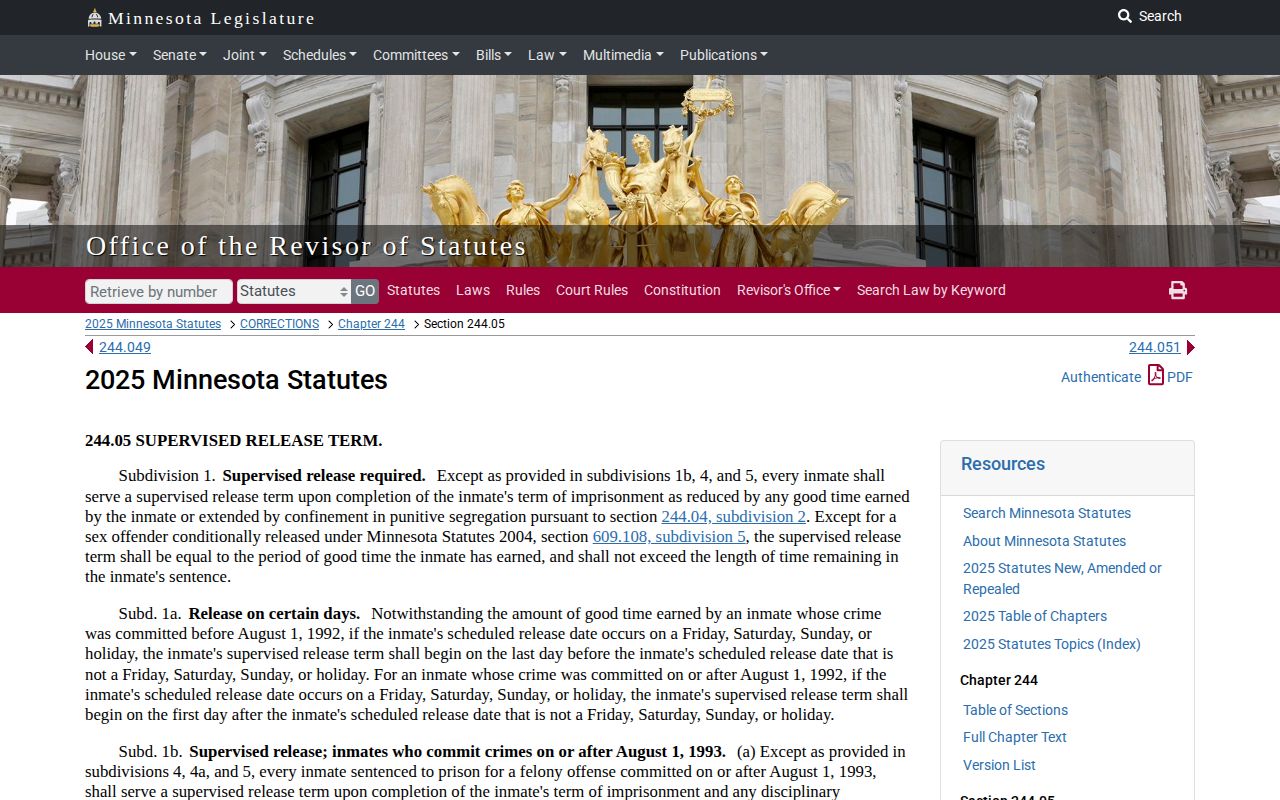
Read the relevant DOC status and court sentence alongside the statute before treating a date as final.
Rice County Release Notifications
Notification depends on the custody system. Minnesota VINE is tied to county jails, including the Rice County custody path. It can report a specific person's custody status and accept registration for a status-change alert. State-prison cases use Minnesota Haven instead. Haven can provide notices about DOC transfers, release, agent assignment, expiration, and listed early-release programs.
A VINE alert does not prove that probation began. It may report release, transfer, or another custody change. For supervision, return to Community Corrections, the DOC detail, and the court sentence. Haven also serves a different source system and does not replace the DOC record. In either channel, automated data may lag behind the agency event.
Note: Minnesota VINE covers Rice County Jail notices, while Minnesota Haven is the separate DOC prison-notification channel.
Rice County Supervision Discharge
Supervision ends through the authority responsible for the sentence. A probation term may expire or be discharged under the court and Community Corrections record. A DOC sentence can reach expiration after its secure and community portions. Board cases follow their own orders and statutory terms. The word discharged should be tied to the exact record because one agency's discharge does not rule out another case or hold.
Check MCRO for public entries such as discharge from probation or satisfaction. For DOC cases, read the current status and sentence-expiration information. Then confirm local supervision with Community Corrections. If the web record is unclear, request existing public data from the agency that created it. Court disposition says what the judge ordered, while corrections data describes administration of the sentence.
A completed term is different from an inactive web result. Search limits, data corrections, sealed records, and retention can affect what appears online. Report only the status the responsible source confirms.